

Derek Jacobi endured a episode of it throughout a international run of Hamlet. Bill Nighy wrestled with it in the run-up to The Vertical Hour premiering on Broadway. Juliet Stevenson has likened it to “a malady”. It has even caused some to take flight: One comedian disappeared from Cell Mates, while Another performer exited the stage during Educating Rita. “I’ve totally gone,” he stated – though he did reappear to finish the show.
Stage fright can trigger the jitters but it can also provoke a complete physical freeze-up, to say nothing of a total verbal block – all right under the gaze. So how and why does it seize control? Can it be defeated? And what does it appear to be to be gripped by the performer’s fear?
Meera Syal explains a typical anxiety dream: “I end up in a costume I don’t recognise, in a part I can’t recollect, facing audiences while I’m naked.” Years of experience did not render her immune in 2010, while performing a try-out of Willy Russell’s Shirley Valentine. “Performing a monologue for two and half hours?” she says. “That’s the factor that is going to trigger stage fright. I was truly thinking of ‘running away’ just before the premiere. I could see the open door leading to the courtyard at the back and I thought, ‘If I fled now, they wouldn’t be able to locate me.’”
Syal gathered the courage to stay, then promptly forgot her dialogue – but just soldiered on through the haze. “I looked into the unknown and I thought, ‘I’ll escape it.’ And I did. The character of Shirley Valentine could be made up because the whole thing was her talking to the audience. So I just moved around the set and had a little think to myself until the lines reappeared. I improvised for a short while, speaking utter nonsense in character.”
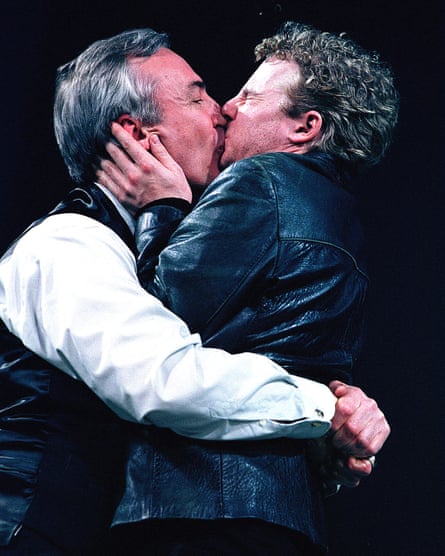
Larry Lamb has faced severe anxiety over decades of performances. When he began as an non-professional, long before Gavin and Stacey, he loved the rehearsal process but being on stage caused fear. “The minute I got in front of an audience,” he says, “it all began to get hazy. My knees would start trembling unmanageably.”
The performance anxiety didn’t diminish when he became a professional. “It persisted for about 30 years, but I just got more skilled at hiding it.” In 2001, he dried up as Claudius in Hamlet, for the Royal Shakespeare Company. “It was the first preview at Stratford-upon-Avon. I was just into my first speech, when Claudius is speaking to the people of Denmark, when my lines got lost in space. It got worse and worse. The whole cast were up on the stage, watching me as I totally lost it.”
He survived that performance but the director recognised what had happened. “He saw I wasn’t in charge but only appearing I was. He said, ‘You’re not connecting to the audience. When the illumination come down, you then shut them out.’”
The director kept the audience lighting on so Lamb would have to acknowledge the audience’s existence. It was a turning point in the actor’s career. “Little by little, it got better. Because we were performing the show for the bulk of the year, slowly the anxiety went away, until I was confident and openly interacting with the audience.”
Now 78, Lamb no longer has the energy for plays but loves his live shows, presenting his own writing. He says that, as an actor, he kept interfering of his role. “You’re not allowing the space – it’s too much you, not enough persona.”
Harmony Rose-Bremner, who was chosen in The Years in 2024, echoes this. “Insecurity and uncertainty go contrary to everything you’re striving to do – which is to be free, release, completely lose yourself in the role. The issue is, ‘Can I allow space in my mind to permit the persona in?’” In The Years, as one of five actors all acting as the same woman in distinct periods of her life, she was excited yet felt daunted. “I’ve grown up doing theatre. It was always my safe space. I didn’t ever think I’d ever feel performance anxiety.”

She recollects the night of the first preview. “I actually didn’t know if I could go on,” she says. “It was the only occasion I’d felt like that.” She managed, but felt swamped in the very opening scene. “We were all standing still, just addressing into the blackness. We weren’t observing one other so we didn’t have each other to interact with. There were just the lines that I’d listened to so many times, reaching me. I had the classic indicators that I’d had in small doses before – but never to this level. The feeling of not being able to take a deep breath, like your air is being drawn out with a emptiness in your lungs. There is nothing to cling to.” It is intensified by the feeling of not wanting to disappoint other actors down: “I felt the duty to the entire cast. I thought, ‘Can I endure this enormous thing?’”
Zachary Hart blames insecurity for inducing his stage fright. A spinal condition ruled out his dreams to be a soccer player, and he was working as a machine operator when a acquaintance enrolled to acting school on his behalf and he got in. “Standing up in front of people was totally alien to me, so at acting school I would go last every time we did something. I continued because it was pure relief – and was better than factory work. I was going to do my best to overcome the fear.”
His debut acting job was in Nicholas Hytner’s Julius Caesar at the Bridge theatre. When the cast were informed the production would be filmed for NT Live, he was “frightened”. Some time later, in the initial performance of The Constituent, in which he was cast alongside James Corden and Anna Maxwell-Martin, he delivered his first line. “I heard my tone – with its strong Black Country speech – and {looked


